

The Westerners often attach great importance to abstract principles, logic and rationality. The principles are respected to the letter, often without regard to the particular human context. The Westerners tend to view all social relations as formal contracts that, once they no longer meet individual needs, can be terminated; while the Chinese attach great importance to the emotional realities of the situation. They seek to avoid absolutes, rely on subtlety and intuition, and take into account the human context in its entirety.
In the negotiations, the Chinese opt for a global approach without giving too much importance to details, while the Westerners, especially the French, are often adept to a more analytical approach, paying attention to each fragment of the table.
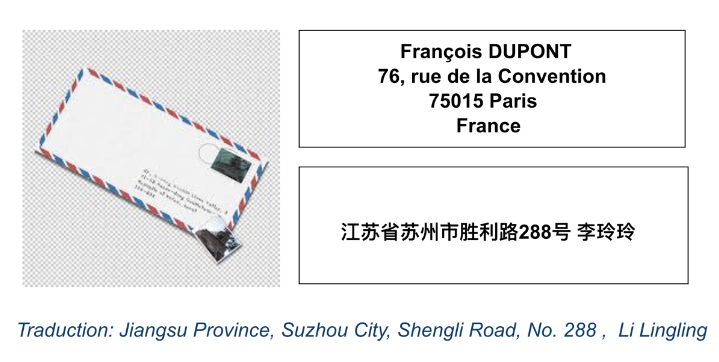 These are two opposite modes of reasoning. The Chinese approach, more pragmatic and global, unfolds from the totality to the parts; whereas the Western approach, more conceptual and analytic, extends from the parts to the totality. What makes it important for a Western company to build its offer does not seem important to its Chinese counterparts. And reciprocally.
  (Illustration: the opposite ways of saying dates and writing envelopes between China and France.)